This one‐day symposium was hosted by the Film Studies Programme at the University of Surrey in 2013 and co-facilitated by Dr. Helen Hughes and myself. It was the fourth in the series ‘Documentary and …’ to be held at the University of Surrey. Disability Studies have transformed debates on the representation of able and disabled bodies alike, demonstrating the ways in which this binary influences the construction and perception of reality. Documentary films such as Niko von Glasow’s NoBody’s Perfect have demonstrated the ways in which contemporary documentary can be used to experiment with and reflect on the myriad forms of representation of disabled bodies that proliferate in industrialised societies from high art to social marketing. At the same time, questions of ethics arise, especially with regards to authorship, stereotyping, mystification and the representation of subjectivity. Whose subjectivities and realities do these films portray? How do they address the balance between aesthetic experience and ethnographic verisimilitude?
Programme
10.00 – 10.30 Registration and Welcome
10.30 – 12.00 Panel 1: Creativity and (Dis)ability
Sapna Ramnani, The challenges of conducting on-camera interviews as spontaneously as possible when the interviewer has Cerebral Palsy and a speech impairment
Hing Tsang, Ability and a productive notion of the hateful in Van der Keuken’s Herman Slobbe.
12.00 – 2.00 Lunch
2.00 – 3.30 Panel 2: Interpreting Documentary Embodiments
Catalin Brylla, Alternative Visions of Blindness: Embodied Space and the Everyday
Slava Greenberg, The Phenomenology of Animated Documentaries on Disability
3.30 – 4.00 Tea Break
4.00 – 5.00 Panel 3: The Documentary Legacy of Thalidomide
Martin Brady, Thalidomide as Spectacle
Anna Drum, Thomas Quasthoff and his (Dis)ability: An Analysis of the documentary film: Thomas Quasthoff – The Dreamer (Michael Harder, 2004)
5.00 – 6.00 Evening Meal
6.00 – 8.30 Screening and Q & A with Adam Isenberg
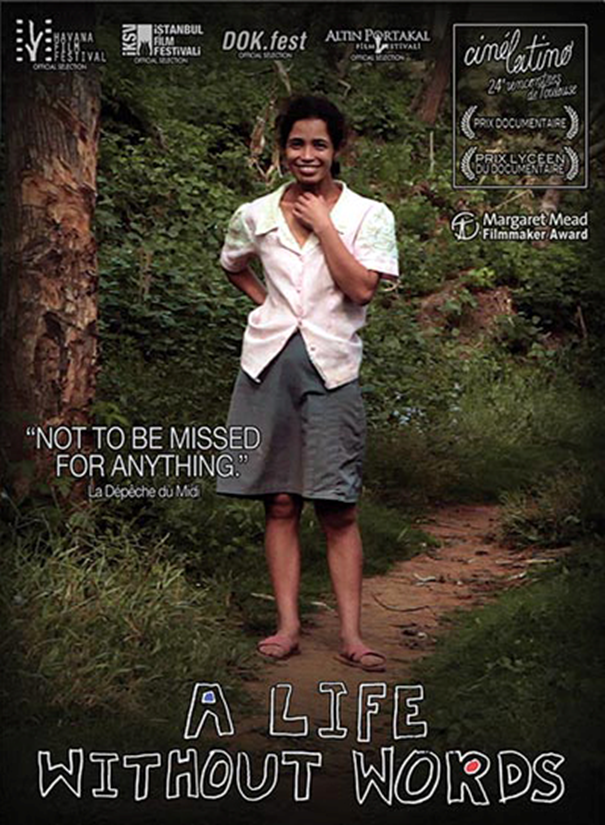
Una Vida Sin Palabras (A Life without Words) Adam Isenberg (2011) http://www.alifewithoutwords.com/
Abstracts and Biographies
The challenges of conducting on-camera interviews as spontaneously as possible when the interviewer has Cerebral Palsy and a speech impairment
Sapna Ramnani
Abstract
The researcher of this study is an independent documentary film-maker with Cerebral Palsy that affects her motor functions. Being a wheelchair user with speech impairment, impacts on the way she produces documentaries.
Through the researcher’s PhD, she argues that it is possible to conduct on camera interviews successfully while having a speech impairment and a physical disability and that this does not compromise the quality of the interview or the levels of comfort of the interviewees themselves. Using herself, reflexively, a series of trials took place where she, as the interviewer, carried out interviews on-camera using various techniques to communicate. She investigated the reactions of sixteen interviewees (fourteen of which were interviewed while sitting down whereas another two were engaged in an activity) to herself as the on camera interviewer using the help of personal assistants and a speech output device to facilitate her communication.
The aim of this research is to enable interviewers with complex physical disabilities and a speech impairment to find possible solutions to overcome physical limitations that they may experience during conducting interviews themselves on camera. A possible outcome of this research could be that some media professionals who are not disabled would gain a better understanding of inclusion both behind the camera and in front of it. This may lead to a positive and more inclusive portrayal of people with disabilities by enabling them to represent themselves on camera and to be a guide to their own production process.
Biography
Sapna Ramnani has been a documentary film maker since completing a Masters in Video in 2000. During her career, she has successfully managed all aspects of production from the initial stages of researching an idea through to filming and editing the rushes. She has produced several documentaries which have been selected for numerous film festivals including screenings at the ICA and the NFT, London. Ramnani is currently studying for a PhD in on-camera documentary interview techniques.
Ability and a productive notion of the hateful in Van der Keuken’s Herman Slobbe
Hing Tsang
Abstract
The theme of disability – irrespective of whether it has been associated with visual impairment or immobility had been a longstanding theme in the work of the late great Dutch filmmaker Johan van der Keuken. This paper looks at an early but key film from his extensive oeuvre Herman Slobbe: Blind Child 2 (1966). Van der Keuken had previously made a more general film about the blind, but he noted the rebellious and angry nature of one of the young adolescent protagonist who seemed to be a trouble maker
It is proposed that rather than centering on the notion of disability as a general social category, the achievements of this film are to displace our attention towards a notion of individual ability. In other words, we might consider disabled people as being first and foremost “capable individuals”, with a capacity for a range of emotional and historical experiences. This takes precedence over facile societal categorisation. In order to this, van der Keuken works through a notion of the “able” individual in a way that is akin to the notion of body mind in Merleau Ponty’s work and the body sign in Charles Sanders Peirce’s semeiotic. In other words, a whole body working together rather than the atomisation of the senses.
But an over-reaching phenomenological approach is also associated with social commitment. This also involves a frank admission of the sexual agency of the individual and an encounter with a notion of the hateful. Therefore, a notion of ability goes somewhat further than what we might associate with a notion of the body sign, but involves dissent and disagreement.
Paradoxically, the latter is what constitutes a notion of the able that transcends the divisions between fully and less bodied individuals.
Biography
Hing Tsang is a teacher of practical filmmaking at University Campus Suffolk. He is the author of Semiotics and Documentary, which is to be published in October 2013 by Mouton de Gruyter and looks specifically at the work of Jon Jost, van der Keuken, and Rithy Panh – informed by both Peircean semeiotic and the phenomenological turn within visual anthropology. He has published previously on the work of van der Keuken and makes films featuring puppetry and landscape.
Alternative Visions of Blindness: Embodied Space and the Everyday
Catalin Brylla
Abstract
This paper presents the methodology of my current PhD by Practice which explores the cinematic representation of blindness and subjectivity through documentary film.
The portrayal of blindness in Western culture has largely constituted of stereotypical representations, branding blind people as either unfortunate, disabled and deprived, or exotic, mysterious and supernatural (Barasch, 2001). Documentaries, such as Black Sun (2005), have followed this trend by imposing themes in relation to memory, trauma, perception, the overcoming of sensorial limitations, and the coping with socio-cultural stigmatisation, resulting in blind people being commonly perceived as “the other”.
This exclusive focus on the ‘extraordinary’ has come at the expense of omitting the ‘ordinary’. As Corbella and Acevedo (2010) observe, “it is infrequent to find characters with visual impairment represented as people who do housework, go shopping, or travel; that is, coping with the everyday tasks that are common to all people”.
Accordingly, the notions of ‘normalness’ and ‘quotidian life’ prove valuable for representing blindness in ways that transgress stereotypical portrayals. The practical output of my PhD endeavours to map blind people’s subjectivity through studying their everyday practices and spaces, as well as artefacts in which they invest emotion and feelings (Baudrillard, 2005), and which potentially serve as an “aide-memoir” – a catalyst for their personal oral history. Daniel Miller (2010) considers attention to materiality (clothes, objects) the most effective way to understand and convey human subjectivity.
The objective of my thesis is to depict the material space of the characters as an embodiment of their subjectivity, and translate their spatial experience into a metaphorical (not iconic) experience for the viewer. Consequently, the audio-visual treatment will propose a shift away from ocularcentric ways of perception towards somatic and synaesthetic modes of experience.
Biography
Catalin Brylla is lecturer in Film and Video at the University of South Wales. Focusing on cognitive film theory, phenomenology, representation and cultural studies, his practice-as-research aims for a pragmatic understanding of audience reception in relation to filmmaking. As a transnational filmmaker his work has been screened and broadcast internationally, and he is currently involved in a film impact study in Tanzania.
The Phenomenology of Animated Documentaries on Disability
Slava Greenberg
Abstract
Social movements are discovering that it is no longer possible to think in cartesian/Kantian ways about the body and society. Social interaction is intercorporeal (Merleau-Ponty, 1962), as well as intersubjective.
What kind of intercorporeal and intersubjective interaction occurs while watching animated images and hearing the actual voices of people with disabilities? How does our sensible-body interact with these indexical sounds and symbolic images? Can they make a body sense the being-in-the-World (in-der-Welt-sein) with disability? Is it possible for these sensations to make the viewers uncomfortable in their own temporarily abled-bodies? And, can we talk about these phenomenological experiences in political terms?
My discussion focuses on two animated documentary series which explore the disabled experience in different cinematic styles: Animated Minds (Andy Glynne 2003) and Creature Discomforts (Lonard Cheshire Disability and Aardman Animations 2007-2008). These two series deal with the meaning of being-in-the-World with disability; Animated Minds explores the invisible disabilities of people with mental illnesses whereas Creature Discomforts explores visible disabilities of people with physical impairments. On the audio level, both series use the indexical voices of people narrating their subjective experiences of disability, but on the visual level, each series uses different animation techniques and cinematic styles. It is the visual differences which create two distinct viewing experiences. Animated Minds bombards the viewer with excessed colorful and metaphoric animated images, while Creature Discomforts uses a realistic “talking-heads” documentary style combined with stop-motion animal clay-mation.
Using Maurice Merleau-Ponty’s Phenomenological method, I analyze the different viewing experiences that these series invoke. I argue that Merleau-Ponty’s idea about the sensible-body enables a better understanding of the viewing experience of the disabled body in animated documentaries. I claim that while the viewing experience of Animated Minds succeeds in allowing the viewer to sense disability, the viewing experience of Creature Discomforts succeeds in making the viewer uncomfortable with the privileges his/her abled-body is socially entitled to.
Biography
Slava Greenberg is a PhD student and a lecturer in the Department of Film and Television, the Faculty of the Arts at Tel Aviv University. Slava has a B.Ed in Special Education and an M.A in Film and Television. She wrote her master thesis on Body in Conflict: The Disintegrated Body in Israeli Post-Second-Intifada Film. Slava teaches a course titled Body in Cinema which focuses on the contribution of the Critical Disability Studies to Cinema Studies. She is currently writing her dissertation supervised by Prof. Anat Zanger on animation and disability using the Phenomenological methodology.
Thalidomide as Spectacle
Martin Brady
Abstract
Thalidomide and its physical effects have rarely been out of the public gaze. The medicine itself, the revelation of its side-effects in the early 1960s, the protracted actions against its manufacturers in Germany and abroad, and the lives of those affected by it, have been reported and analyzed in books, articles, films for both large and small screen and performances; these range in approach from scientific analysis through political polemic to personal histories and, especially in recent years, autobiographical reflection. Following an introductory survey of recent representations of thalidomide and its history, including the controversial television film Contergan (Thalidomide, Adolf Winkelmann, 2007) and Andreas Fischer’s documentary Contergan: Die Eltern (2003), this paper will concentrate on the representation of children and adults in two remarkable experiments in subverting conventional views of the thalidomide body: Werner Herzog’s Behinderte Zukunft (Disabled Future, 1970) and NoBody’s Perfect (Niko von Glasow, 2008). Both works not only question how disability, and by implication otherness more generally, is viewed and represented (in implicit opposition to normative modes of spectatorship), but also present impairment as positive creative capital.
Biography
Martin Brady teaches in the German and Film Studies Departments at King’s College London. He has published on film (Straub-Huillet, Michael Haneke, Robert Bresson, experimental film, literary adaptation, GDR documentary film, Kafka films, Adorno and cinema, Brechtian cinema, Heimat 3, Downfall, Ulrich Seidl), music (Arnold Schönberg), literature (Paul Celan), visual arts (Anselm Kiefer), Jewish exile architects, foraging (in Stifter, Handke, and Beuys), and the portrayal of thalidomide. A book on the collaborative films of Wim Wenders and Peter Handke, co-authored with Joanne Leal, was published by Rodopi in 2011. He has translated Victor Klemperer’s LTI and Alexander Kluge’s Cinema Stories (with Helen Hughes), and works as a freelance translator and interpretor.
Thomas Quasthoff and his (Dis)ability: An Analysis of the documentary film: Thomas Quasthoff – The Dreamer (Michael Harder, 2004)
Anna Drum
Abstract
In an interview with the German “Spiegel” the German Singer Thomas Quasthoff said: “There was certainly a bonus for being disabled. But you only get it once.” Often it is difficult to hide a disability. In case of Thomas Quasthoff, who is a thalidomide victim, it is nearly impossible. Most covers of his music CDs are designed with the portrait of his head. These covers do not reveal that in reality, he has shortened arms and missing fingers. His legs were short, so that he reaches only a body height of four feet three inches. It is clear that these ‘defects’ influence his life and the interaction with the environment. In this paper I want to show the way of presenting the person of Thomas Quasthoff and his (Dis)ability by analyzing the documentary film “Thomas Quasthoff – The Dreamer” a film by Michael Harder (2004).
The main questions (focus) are:
- What kind of pictures/strategies of visualization will be used to reveal or conceal his disability?
- Are there issues relating to privacy or (Dis)ability being a taboo?
- By describing the handicap, the film uses the flashback of his childhood. In which way does the film represent the present? (Relationship between present and past in the context of the presentation of his (dis)ability)
- What are the main reasons for this film being described as “a beautiful and inspirational story”?
For me as an art historian the medium film makes clear that the potential of iconology (description, analysis and interpretation of icons and iconic representations) is not yet exhausted. ‘Disability’ and ‘images’ are not considered by themselves, but are a construct of assignment by a culture. The main question for me is the strategy of visualization. I’m writing my PhD thesis about the functionalization of (human) size in the visual presentation/picture since the 20th century. It seems that modern arts exclude ‘disease/disability’ much more than film, or, both reappraise these categories. My main methodology is the iconology/iconography (E. Panofsky) to describe the visual language.
Biography
Born 1982 in Kappeln (Northern Germany). December 2010 Magister exam in History of Art, Romance Philology (French), Modern German Literature and Media Science at the University of Kiel. 2009-2011 student assistant and graduate assistant at the Institute of Art History at the CAU of Kiel. Since 1989 regular contributor to the Art Gallery Drum in Schleswig (Northern Germany). Since 1999 work as photographer for magazines and book publishing. Since April 2011 writing a PhD-Thesis.
Film Screening: A Life Without Words (2011)
Dir.: Adam Isenberg
WINNER – 2012 MARGARET MEAD FILMMAKER AWARD
36th Margaret Mead Film Festival. New York.
WINNER – PRIX DOCUMENTAIRE & PRIX LYCÉEN
24th Cinelatino International Film Festival. Toulouse, France.
SPECIAL MENTION – EMERGING INTERNATIONAL FILMMAKER
Open City London Documentary Film Festival. London.
In rural Nicaragua, Dulce María (28) and her brother Francisco (22) are Deaf and know no language–spoken, written or signed–until Tomasa, a Deaf sign-language teacher working for a local NGO, arrives determined to teach them their first words.